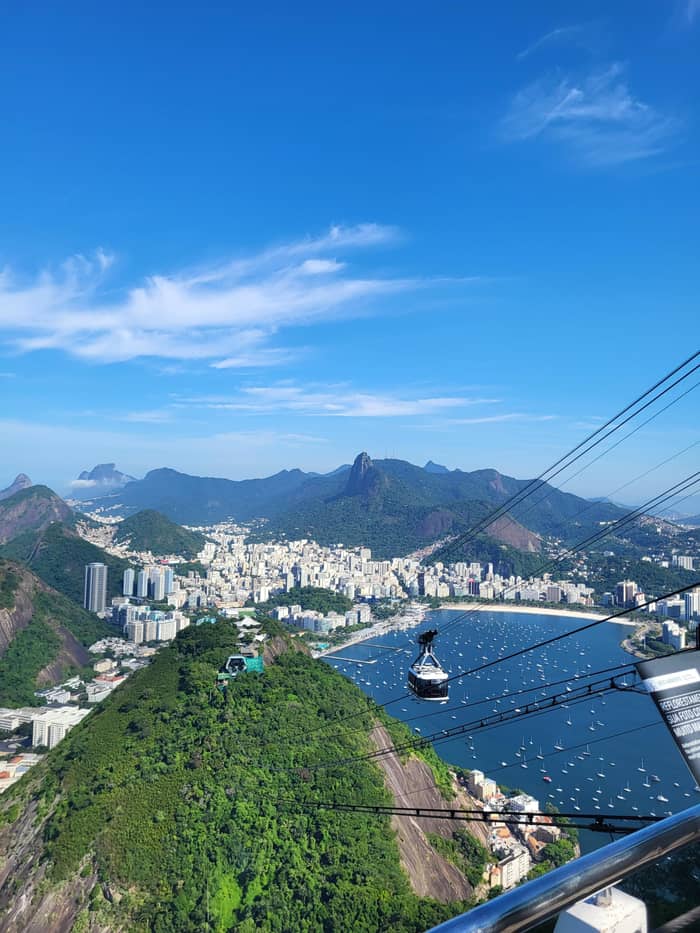
4 hours
Tram, steps and Lapa
Santa Teresa by tram, then on foot
- PickupIncluded
- Guide4 languages
- CancelUp to 24 hours ahead
Map your stop
Rio de Janeiro: Santa Teresa Tram Tour, Selarón Steps & Lapa
★ 4.5 · 639 user reviews
Look at 57 stops
Pick a route, then tap a marker or a stop for notes and a Google Maps link.
Jorge Selarón started tiling these 215 steps between Lapa and Santa Teresa in 1990.
Google MapsThe old Carioca Aqueduct, with 42 large double arches, now carries the Santa Teresa tram.
Google MapsLaurinda Santos Lobo's old mansion, now a free cultural centre with a view over the bay.
Google MapsCastro Maya's former home, listed by IPHAN in 1974, with art collections on three floors.
Google MapsThe Santa Teresa tram leaves from here every 30 minutes, 16 passengers to a car.
Google MapsA cone 75 m high outside, inspired by Chichén Itzá, with room for 20,000 people standing.
Google MapsOpened in 1909 on a design inspired by the Paris Opera; guided visits sell at the box office.
Google MapsThe historic tea room of downtown, with a second branch inside Copacabana Fort.
Google Maps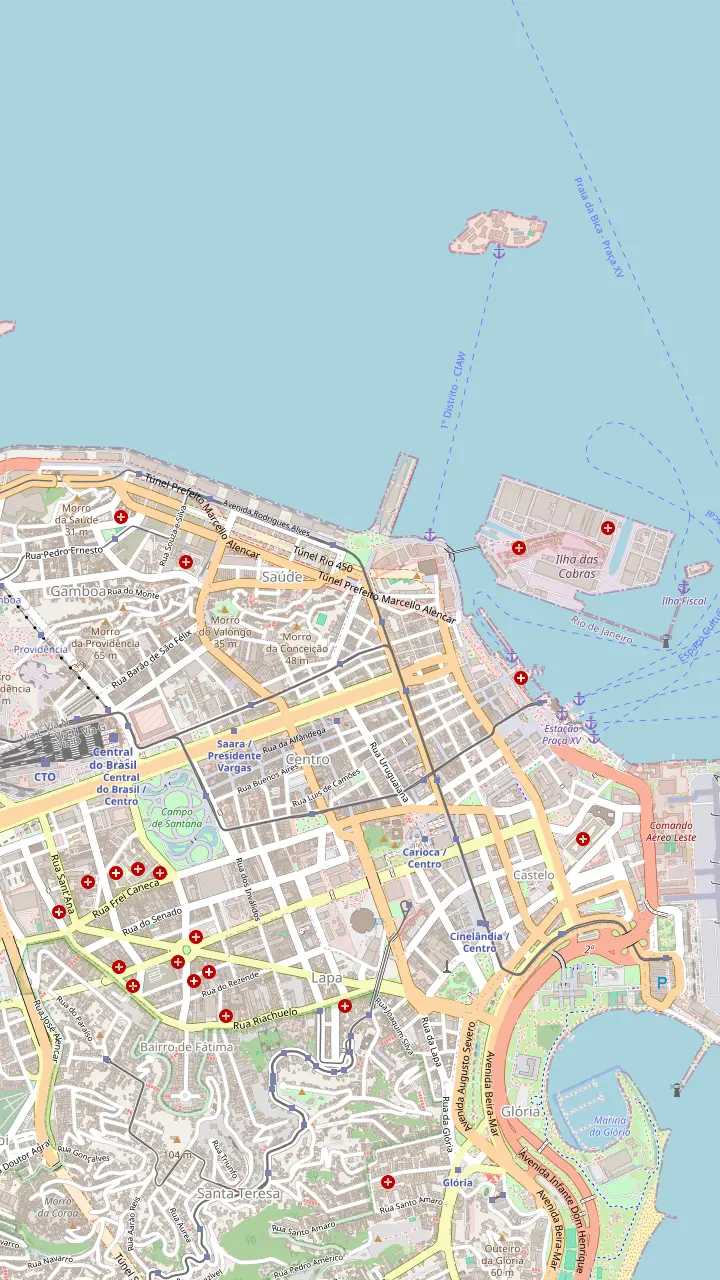
The historic tea room of downtown, with a second branch inside Copacabana Fort.
Google MapsA reading room founded in 1837 that holds 350 thousand titles by Portuguese authors.
Google MapsBuilt in 1743 for the viceroys, now a cultural centre with free entrance.
Google MapsA grand downtown church a short walk from the CCBB and Praça XV.
Google MapsA cultural centre since 12 October 1989, in a building from 1880.
Google MapsThe rock in old Little Africa where urban carioca samba was born.
Google MapsAbout 1 million enslaved Africans arrived through this wharf, built in 1811.
Google MapsA museum about the future of the planet and the impact of what we do now.
Google MapsThe Rio Art Museum on Praça Mauá, next to the Museum of Tomorrow.
Google Maps
Quieter than its neighbour, under Pedra do Leme and its colonial fort.
Google MapsAlmost 4 km of sand from the Leme Fort to the Copacabana Fort, divided into posts.
Google MapsBuilt in 1914 to defend Guanabara Bay; now the Army Historical Museum.
Google Maps800 m of beach and the rock where people clap the sunset over Dois Irmãos.
Google MapsThe meeting point of Ipanema's 2 km beach, between Arpoador and Jardim de Alah.
Google MapsAbout 1 km of sand with a children's area, the baixo bebê.
Google MapsAround 400 m of sand at the foot of Dois Irmãos hill.
Google MapsStrong surf and the landing beach of the hang gliders from Pedra Bonita.
Google MapsOnly 300 m long and reached through a gated community; check the tide.
Google MapsThe longest beach in the city, 14.4 km, with 12 lifeguard stations.
Google Maps8 km of quiet sand in an environmental protection area.
Google MapsA 2.8 km cove at the end of Lúcio Costa Avenue, popular for surfing.
Google Maps700 m of surf beach inside a municipal natural park.
Google MapsA protected beach where building is prohibited, with strong waves.
Google MapsCalm water under Sugarloaf, named for its reddish sand; the cable car starts here.
Google MapsA bay beach close to the centre, facing Sugarloaf.
Google Maps
A short, quieter stretch at the start of the Copacabana seafront.
Google MapsMetro stations Cardeal Arcoverde and Siqueira Campos, and the tourist police base.
Google MapsMetro General Osório and Nossa Senhora da Paz, a 2 km beach and the Sunday hippie fair.
Google MapsMetro Antero de Quental on line 4, a family beach and the tourist police station.
Google MapsThe metro stop for the Sugarloaf bus, on Botafogo Cove.
Google MapsFlamengo Park and a bay beach, close to the centre.
Google MapsNamed by Time Out among the world's coolest neighborhoods; Sunday fair with 150 vendors.
Google MapsThe hill neighborhood called Rio's Montmartre, with its tram from 1872.
Google MapsThe cradle of bohemian Rio, under the arches.
Google MapsTheatres, churches and museums, linked by the VLT light rail.
Google MapsA quiet bay-side district below Sugarloaf, with the Mureta wall.
Google MapsRio's longest beach, metro Jardim Oceânico, and the BRT to the airport.
Google Maps
Jorge Selarón started tiling these 215 steps between Lapa and Santa Teresa in 1990.
Google MapsA museum about the future of the planet and the impact of what we do now.
Google MapsBuilt in 1914 to defend Guanabara Bay; now the Army Historical Museum.
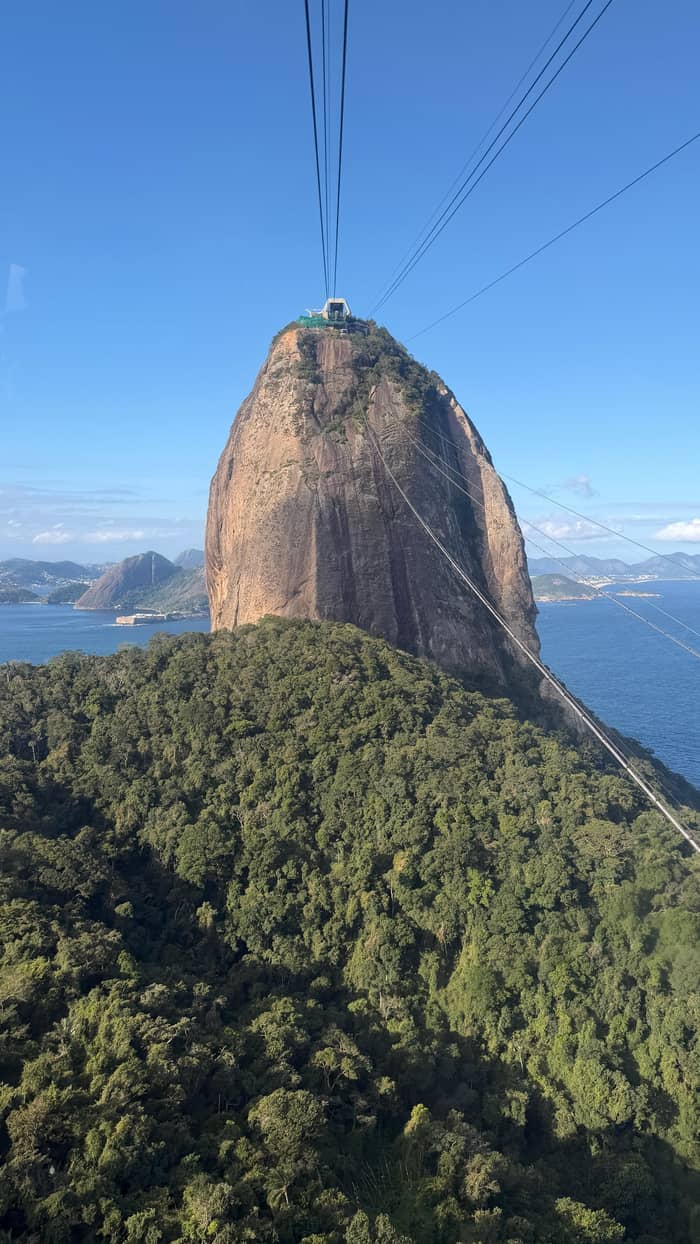
Google Maps2 lines from Praia Vermelha via Urca Hill to the 396 m summit.
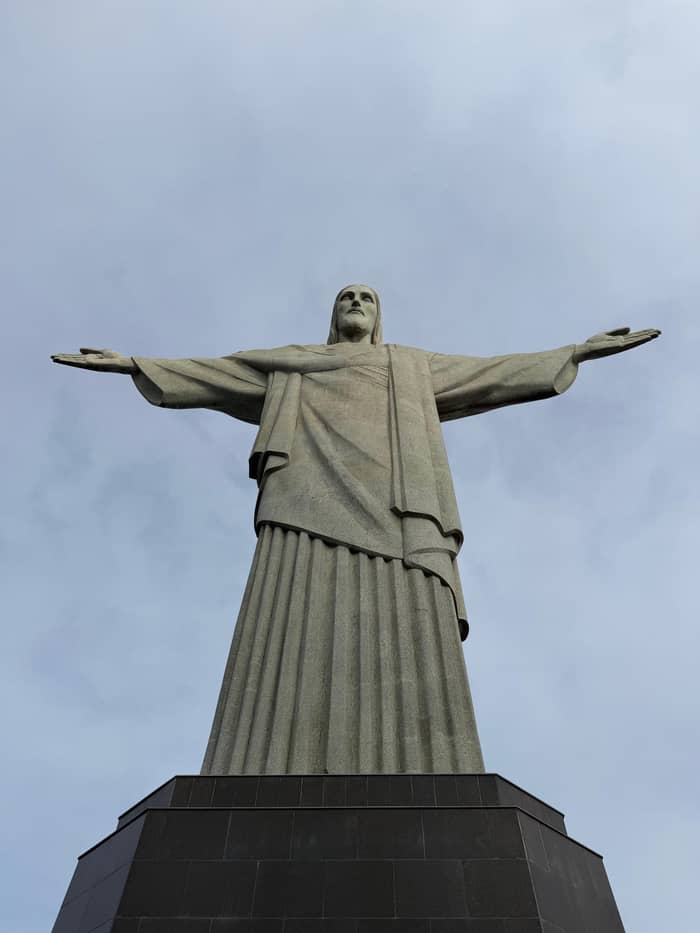
Google MapsThe statue on Corcovado, one of the postcards of Tijuca National Park.
Google MapsOpened on 16 July 1950; the stadium tour goes behind the scenes.
Google MapsCreated in 1808 by Dom João VI; arboretum open from 8 AM on most days.
Google MapsAn 8 km path around the lagoon for walking and cycling.
Google Maps52 hectares at the foot of Corcovado, with a garden designed in 1840.
Google Maps28 tanks and 4.5 million liters of salt water in the port zone.
Google MapsThe royal family's home from 1808 to 1889; free entrance.
Google MapsMore than 600 exhibitors on Praça General Osório.
Google MapsA paved viewpoint built as a tribute to the Chinese and tea growing in Brazil.
Google MapsWhere the Last Ball of the Empire was held; a 10-minute boat crossing.
Google MapsAbout 70 booths of northeastern Brazilian culture.
Google MapsThe park's visitor centre on Estrada da Cascatinha, with its permanent exhibition.
Google MapsMapping data © OpenStreetMap contributors
A Rio walking tour through the oldest streets in town: the tiled steps, the aqueduct and its tram, Santa Teresa's hill, the colonial centre and the port where samba began.
Editorial team, riodejaneirotour.click · Updated November 11, 2026 · Takes 8 min
Quick look
A Rio walking tour of the centre is a different city from the beaches. Here the streets are colonial, the churches gilded, and the hill behind them holds a neighborhood of 19th-century mansions and stairways.6 The heart of it is a staircase: Jorge Selarón began covering it in tiles in 1990,2 and the city now counts 215 steps clad in thousands of tiles from around the world, linking Lapa with Santa Teresa.1 In 2025 it drew more than 1.5 million visitors, according to the city's tourism observatory.7
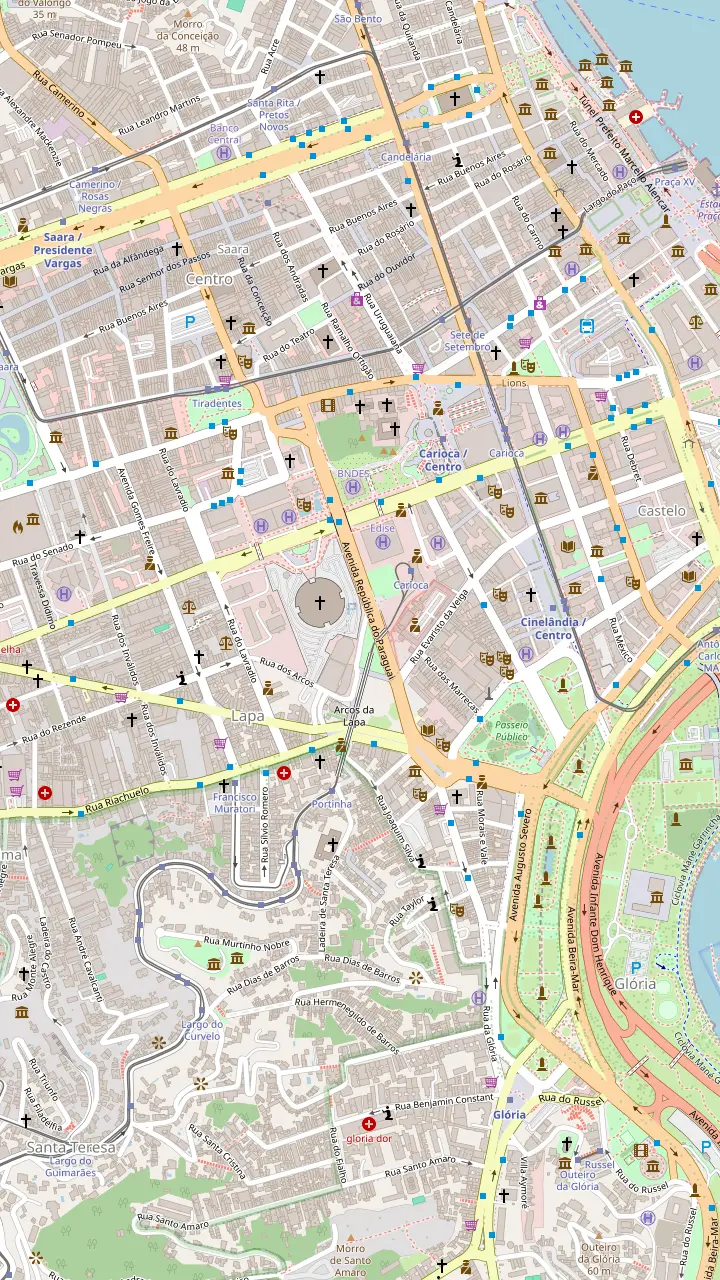
From the foot of the steps everything on this page is within walking distance or a short tram ride. Uphill lies Santa Teresa, with its museums and studios; downhill, the Lapa Arches and the cathedral; further north, the old squares of the centre and the port district called Little Africa. The map further down splits this ground into a panel for Lapa and Santa Teresa and another for the historic centre and the port. Plan a full day for all of it, or split it into a morning on the hill and an afternoon downtown.
Walk it in daylight and on a weekday if you can, when the centre is busy with office workers and the museums are open. British travel advice warns that favelas can sit right beside visitor areas,8 and that a phone's walking directions may route you through one, so check the line on the map before you follow it.9 Santa Teresa's lanes wind close to some, so stay on the main streets or go with a guide. The night side of Lapa, with its bars and samba, is a different outing and not part of this walk.
Stops on the walk
| Stop | Area | What to know |
|---|---|---|
| Selarón Steps | Lapa and Santa Teresa | 215 tiled steps1 |
| Lapa Arches | Lapa | 42 double arches24 |
| Parque das Ruínas | Santa Teresa | Free cultural centre5 |
| Metropolitan Cathedral | Centre | Seats 5,00025 |
| Theatro Municipal | Centre | Guided visits, groups of 5026 |
| Paço Imperial | Praça XV | Free entrance4 |
| Valongo Wharf | Little Africa | Built in 181111 |
Details from Riotur's pages for each place; opening hours change, so check before you go.15
The stairway climbs from Joaquim Silva Street in Lapa to Pinto Martins Street in Santa Teresa, 5 minutes on foot from the Lapa Arches.15 Selarón was a Chilean artist, and his work gathers tiles from many parts of Brazil and the world.16 Look closely as you climb: national flags, painted scenes and tiles from faraway countries sit side by side. Riotur's own highlights route speaks of more than 200 steps,17 and the city puts the exact number at 215.1
The steps have starred in U2 and Snoop Dogg music videos,18 and in 2015 the city recognized them as part of its historic and cultural heritage.19 That fame brings crowds. Come soon after breakfast for photos without a crowd on every step, or toward evening, when the colors turn warmer. Stand a few flights up and shoot down toward Lapa for the classic view of the whole staircase, and give way to residents carrying shopping up the hill.
The area at the bottom is changing. The city has started building the Boulevard Selarón, an investment of BRL 1.7 million in wider pedestrian areas, level paving, new sidewalks and ramps.20 The plan also adds a drop-off bay for tour buses and vans on Rua Visconde de Maranguape, near the Sala Cecília Meireles concert hall.21 Expect some building work around Joaquim Silva Street while it lasts, and check the route on the day.
The white Lapa Arches were built as the Carioca Aqueduct, and they are one of the best known sights of old Rio, with 42 large double arches.24 Riotur calls them the largest architectural work carried out in Brazil in the colonial period.28 Since 1896 the aqueduct has carried the tram that links the centre with Santa Teresa,29 which makes the arches a bridge you can ride across. Walk underneath for the full scale, then look for the tram crossing on top.
The Santa Teresa tram itself dates from 1872 and still works as local transport as well as an attraction.12 It leaves from Carioca station downtown and runs to Dois Irmãos at the end of the line, with a ride every 30 minutes and room for 16 passengers in each car.3 Riotur notes that departure times are estimates and can change,3 so build in a wait. The open sides give you the view; keep bags on your lap and phones in a pocket on the narrow climbs.
A good plan is to ride up and walk down. Take the tram from Carioca to the top of the hill, wander Santa Teresa's main street, then come down on foot by the Selarón Steps into Lapa. You see the arches from above and below, and you finish at the bottom of the steps without climbing all 215 in the heat.1 If the tram queue is long, a taxi or ride app to Largo dos Guimarães does the same job in a few minutes.
Plan your walk
Choose by time, budget and how much context you want.
If I have a single morning
Tram up, steps down
The tram leaves Carioca every 30 minutes; walk down by the steps into Lapa.3
If I want the history of slavery and samba
Little Africa walk
2.5 hours through the port, Pedra do Sal and the Valongo Wharf.
If I am on a tight budget
Free sights and a free walk
The Paço Imperial and the Ruínas centre are free; the walk starts from $12.4,5
If I want architecture inside
Cathedral and theatre
The cathedral seats 5,000, and the theatre runs guided visits.25,26
If I want it all arranged
Guided half day
Tram, steps and Lapa in 4 hours with hotel pickup.
Ways to walk it
4 hours
Santa Teresa by tram, then on foot
2.5 hours
The port, the wharf and Pedra do Sal
Small group
Historic centre and Lapa
A walking tour of Santa Teresa shows why Riotur calls the neighborhood Rio's Montmartre: a historic, artistic hill just above downtown.27 Riotur's own itinerary lists 8 stops, from museums to studios and a pastry kitchen.98 Its European-style houses, churches, alleys and stairways went up in the 19th century and are still there.6 Walk slowly, look through the gates, and expect cobbles: wear shoes with grip.
Start at the Parque das Ruínas, once the mansion of Laurinda Santos Lobo, the great patron of Rio's Belle Époque.30 The restored ruin is now a cultural centre with free entry and a terrace over downtown and Guanabara Bay.5 Next door, the Chácara do Céu Museum was the home of the collector Castro Maya, and IPHAN listed it as heritage in 1974.31 Its rooms hold art collections from many periods, rare books and furniture.
For a quieter view, the Rato Molhado viewpoint at the top of the hill looks over Guanabara Bay, Santos Dumont airport and Glória.99 Then visit the studios: Bonzolândia, where Getúlio Damado turns cans, bottles and other recycled material into art,100 and the painters' workshops along the main street. Most studios welcome visitors who ask first, and buying a small piece directly from the artist is the best souvenir the hill offers.
Price a guided walk
Choose a walk, then enter how many of you are coming.
Choose from 4 options
Choose a walk, then enter how many of you are coming.
≈
View≈
View≈
View≈
ViewStarting prices on GetYourGuide, exchanged at the ECB reference rate. The booking page gives the exact price.
Old Rio
1743
The Paço Imperial is built on Praça XV.10
1811
Built where enslaved Africans were landed.11
1872
Santa Teresa gets the tram it still uses.12
1909
The Theatro Municipal, modelled on the Paris Opera.13
1979
The Metropolitan Cathedral opens on 15 August.14
1990
Selarón starts work on the staircase.2
Downhill from Lapa stands the Metropolitan Cathedral, opened on 15 August 1979 to a design by Edgar de Oliveira da Fonseca.14 Its cone rises 75 m outside, with an interior 64 m high,22 and it holds 20,000 people standing or 5,000 seated.25 The shape takes its cue from the Mayan pyramid of Chichén Itzá, but round instead of square.32 Inside, the stained-glass windows climb from floor to apex, and the 18 m main door carries 48 bronze panels.23
A few blocks east, the Theatro Municipal opened in 1909 on a design inspired by the Paris Opera.13,33 Guided visits take groups of 50, and tickets go on sale at the theatre box office 30 minutes before each visit.26 Nearby, the church of the Third Order of Saint Francis of Penitence, finished in 1748, ranks, in Riotur's words, among the country's finest Baroque and Rococo interiors in the Portuguese-Brazilian style.101,102 The Real Gabinete Português de Leitura, founded in 1837, keeps 350,000 titles by Portuguese authors in its reading room.35,36
End at Praça XV by the water. The Paço Imperial was built in 1743 as the house of the viceroys and became the seat of the kingdom and empire after Dom João VI arrived;10 today it is a cultural centre with exhibitions all year and free entrance.4 The Old Cathedral nearby is where both emperors, Pedro I and then Pedro II, were crowned, and where the royal weddings took place.103 The CCBB on Primeiro de Março Street has been a cultural centre since 12 October 1989.37
Video
Sarah Travels on YouTube · Your tap on play is what loads the video.
also known as Rio’s Montmartre, and it’s situated nearby downtown on top of a hill.
Before you set off
North of the centre, the port district carries a harder history. Little Africa covered what are now Saúde, Gamboa, Santo Cristo and part of downtown, the first home of Africans brought to Rio and of their descendants.39 According to historians, about 1 million enslaved Africans arrived through the Valongo Wharf,40 built in 1811 and remodelled in 1843 to receive the Empress Teresa Cristina.11 The wharf was rediscovered under earth during the Porto Maravilha works.104
Pedra do Sal, a rock on Conceição hill, is where urban carioca samba was born,38 and on National Samba Day, 2 December, the local quilombo community celebrates the washing of the stone.105 The port's renewal began after 2010 and brought several historic places back to light.106 By day the area is quiet and best seen with someone who knows its stories: many sites are small, unmarked or easy to walk past.
A Little Africa tour in Rio de Janeiro with a guide takes 2.5 hours from $39 and has 241 reviews averaging 4.8. It starts in front of the Museu de Arte do Rio and stops at Morro da Conceição, Largo de São Francisco da Prainha, Pedra do Sal, the Hanging Garden of Valongo and the Valongo Wharf. The guiding is in English, and a full refund is possible until 24 hours before. Combine it with the museums on Praça Mauá for a full day in the port.
A free walking tour in Rio de Janeiro exists, but read the terms. The listing on GetYourGuide covers historic downtown and Lapa, meets in front of the Arcos da Lapa and keeps groups to 10 people, from $12. Guides work in English, Italian, Spanish and Portuguese. With only 16 reviews it is a small operation, and it suits travelers who want a local's company on a budget and do not mind a simple format.
Paid walks add structure. A historical downtown and Lapa walk of 3 hours starts in front of the Theatro Municipal on Praça Cinelândia, with groups of up to 10, from $61. A downtown walking tour of 4 hours, guided in Portuguese, Spanish, English, Italian or French, starts from $46. For Santa Teresa, the historic Rio half day of 4 hours includes pickup and is wheelchair accessible, from $64.
The listing this page books combines the Santa Teresa tram, the Selarón Steps and Lapa in 4 hours with pickup, from $71, and has 639 reviews averaging 4.4. Its guides speak Chinese, Spanish, English and Portuguese. If you would rather walk alone, use the map on this page and the order above, and keep the guided option for Little Africa, where the context matters most and the small sites are easy to miss.
FAQ
The city counts 215 steps covered in tiles from around the world.1
He began tiling the staircase between Lapa and Santa Teresa that year.2
The tram runs to Dois Irmãos every 30 minutes, 16 passengers a car.3
It meets at the Arcos da Lapa with groups of up to 10, from $12.
Tickets go on sale at the box office 30 minutes before each visit.26
It covered Saúde, Gamboa, Santo Cristo and part of downtown.39
It is a cultural centre with exhibitions all year and free entrance.4
The tram, steps and Lapa tour lasts 4 hours with pickup.
Sources
Touring Rio? Ask a real person here.